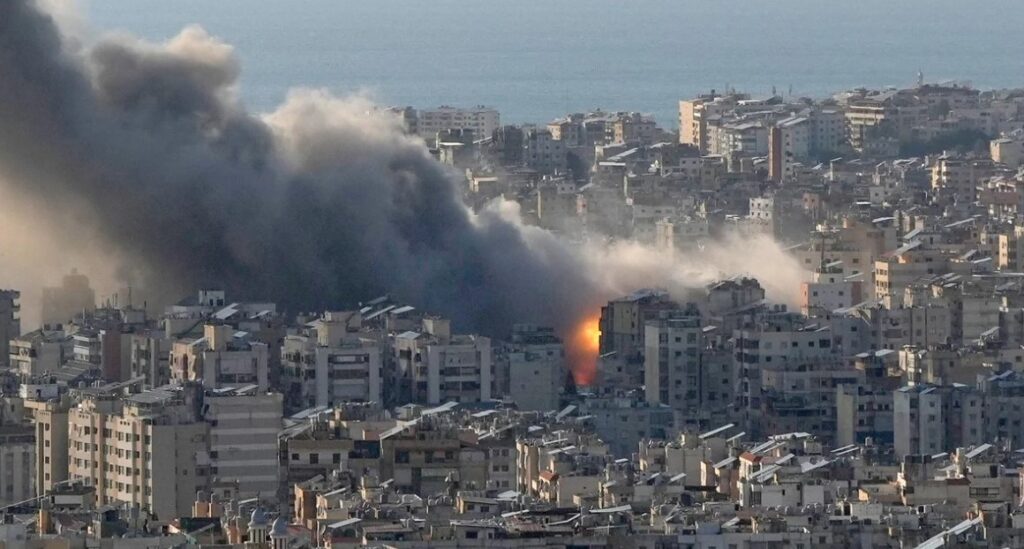
The Human Cost of US-Israeli War against Iran: Why Peace Should Be the Ultimate Goal
By: Vol Adeyemi Aleshinloye, Esq.
Ed. 242 || 26.08.2026
“ War is mankind’s most tragic and stupid folly; to seek or advise its deliberate provocation is a crime against all humanity.” – Dwight Eisenhower, 34th US President
There is something spurious about the leader of a country instigating military action against a neighbouring nation, mostly out of a need to distract his country’s parliament from his own legal infractions; but it is equally concerning that any nation would breach its foreign policy commitments to the international community by setting in motion a nuclear arsenal with the potential to unsettle regional security.
Throughout all of world history, warring nations have always found some justification for their provocation and continuous engagement in combat, contrary to nature’s and human reason’s proclivities to preserve life and stability of human society. However, as English novelist Ernest Hemingway has rightly said, war, no matter how necessary or justified, is nothing but a crime.
The criminality of war is best measured in terms of the gravity of human suffering it occasions. A rule of thumb in legal logic and moral reasoning considers immoral and criminal any act done by a person which threatens the life, liberty or property of another. It is this rational human instinct that has led to the worldwide criminalisation of such heinous acts as murder, rape, kidnapping, arson, theft, etc.
Meanwhile, as political leaders strive to keep the wheels of justice running smoothly within their national borders, some contradict the collective goal by instigating military action that would result in the greatest amount of suffering for the citizens of another nation and their own alike. As the 17th-century French physicist and philosopher commented, ‘Can anything be stupider than that a man has the right to kill me because he lives on the other side of the river and his ruler has a quarrel with mine, though I have not quarrelled with him?’ Yet, despite its inherent folly and apparent costs in terms of human suffering, this evil invention of mankind has survived for almost all of human modern history.
The U.S., like the meddlesome ‘Big Brother, ’ has persistently, without the United Nations’ requisite sanction, meddled in Israeli-Palestinian relations due to supposed concerns about stability in the Middle East and the apparent protection of its own interests within the region.
As a long-standing partner to Israel, the United States’ disposition to this triangular affair seems to have been that whatever is in Israeli interest is also in America’s interest. This orientation was voiced most ferociously by US President Donald Trump on Truth Social in March 2026 that Making America Great Again (MAGA) “includes not allowing Iran, a Sick, Demented, and Violent Terrorist Regime, to have a Nuclear Weapon to blow up the United States of America, the Middle East and, ultimately, the rest of the World.”

The ongoing conflict between the U.S.-Israel and Iran commenced on February 28, 2026, following an attack by Israel on Iranian military bases. The United States, under the leadership of President Donald Trump, who had previously condemned former President Joe Biden for getting the U.S involved in the Russo-Ukrainian war and had campaigned on the promise to end the war, would, in an unimaginable turn of events, start another war. U.S intervention eventually resulted in the killing of the Iranian Supreme Leader, Ayatollah Ali Khamenei, several soldiers and countless civilians.
Of course, the US/Israeli-Iranian war is not the first regional conflict this world has witnessed in recent years. Still ongoing is the Russo-Ukrainian war, and just a few months ahead of the attacks on Iran was Israeli military occupation in Gaza, resulting in conflict with Palestine. Whilst these regional conflicts do not parallel the world wars in terms of mortalities, the human cost of these wars is not negligible.
The Russo-Ukrainian war has claimed nearly two million lives, according to official reports by Ukraine’s Ministry of Defence, with about 2,000 civilian deaths in the first half of the year 2026 on both sides. In a similar vein, Israeli military occupation in Gaza has resulted in the deaths of more than 70,000 Gazans, 44% of whom are children.
The human cost of the US-Israeli war against Iran is at least 7,300 precious human lives, according to the BBC (though another source estimates it to range between 8,976 and 18, 310). This is not just a number; it is representative of the risk of death for every soldier fighting for any of the three warring countries, and countless civilians who have either by premeditation or sheer chance suffered the misfortune of death as a direct consequence of the war. This number includes about 18 to 20 U.S. Army officials who died fighting a war that the majority of the citizens of their own country now consider unpopular.
More importantly, this is evidence of the risk of loss of the precious gift of life. However horrific the reporting of these casualties as encapsulated above may be, perhaps more gruesome are the indirect consequences of war, namely the long-standing effects it has on the families of the casualties who become long-term victims of war, psychological impacts on children survivors of war, displacement of communities, disruption of education and social bonds, and permanent physical harm for countless survivors.
We, who are nationals of countries not engaged in the ongoing conflict and seemingly enjoying relative peace at the moment, may ask why we should be concerned about the political situation of countries in distant regions. The reason lies in our understanding of the folly of war, which, as Eisenhower said, is indeed a crime against all humanity. Senseless war in one region gives belligerent leaders in another the permission to provoke wars. But when we, as global citizens, decry this evil imagination, we secure for our children’s generations a world genuinely moving toward the direction of peace one step at a time.
Also Read: The Role of Vigilante Groups in Community Policing as a Strategy for Security Enhancement
Featured Image Credit: The Guardian, UK
Facebook: Peacepace Initiative
LinkedIn: Peacepace Initiative
X:@PeacepaceNG
Instagram: peacepace_initiative