Nigerian Federal Roads Are Now Death Traps: A Call for Responsible Governance
By: Vol. Benedict Kanu
Ed. 232 || 05.01.2026
It is no longer news that the state of Nigerian inter-state roads has deteriorated into not just death traps, but highways leading many to untimely graves. Far too often, Nigerians fall prey to tragic road incidents that could have been prevented.
For instance, a few years ago, on my way from Calabar to Lagos along the Lagos–Ibadan Expressway, I witnessed a horrific accident. We had to pull over, and after making enquiries, I learned that this was the fifth accident occurring at that same spot — all caused by drivers attempting to dodge a pothole they could not notice on time.
In addition to accidents, many federal roads have become hotspots for armed robberies whuch stems from insecurity. For instance, the Nasarawa–Akwanga axis and the Benue–Enugu roads have recorded multiple attacks, forcing travellers to pause their journeys and spend nights on the highway in order to avoid falling victim. I personally witnessed some of these during the Muhammadu Buhari administration.
These life-threatening dangers have made many Nigerians afraid of travelling by road and prefer alternative means of transportation whenever possible.
To further justify the stated concern, Yusuf and Nimlan, in their article “The Nigerian Road Network: The Horror Highway of Death” (2021), identified several federal roads notorious for fatal incidents. Among them are the Lagos–Ibadan Expressway, Lagos–Abeokuta Expressway, Ibadan–Akure road, Shagamu–Ore road, Benin–Shagamu road, Onitsha–Enugu–Port Harcourt road, Jos–Abuja road, and the Kogi–Benin road. According to the authors, potholes and the deplorable state of these highways regularly strand travellers, extending journeys that should take hours into dangerously long nights on the road.
Though the Lagos-Ibadan Expressway has now witnessed rehabilitation, but its 1 in 100. The Ibadan-Ife Expressway has long been a concern for travellers, as it’s fast becoming another hot spot for kidnappers and armed robbers.
In a more recent publication, Emma Amaize of Vanguard Newspaper, dated 14 May 2025, reinforced this narrative by stating that from the South-South to the South-West, South-East, North-Central, North-East and North-West, the story remains the same. Rather than facilitating smooth movement, many federally-owned highways are deteriorated to the point of endangering lives. Coupled with reckless driving and climatic factors, these roads have become prone to frequent accidents, resulting in loss of lives and property worth millions of naira.
Furthermore, the author observed that construction, reconstruction, and rehabilitation projects are often stalled due to disputes over project costs between the government and contractors, thereby worsening the plight of road users. He cited the pitiable condition of the Itu–Calabar highway connecting Akwa Ibom and Cross River, the Bida–Lapai–Agaie road in Niger State, and the Minna–Lambata–Suleja roads. These roads have consumed lives “like a snake swallowing free eggs” because of their deplorable state and lack of timely intervention.
However, the Federal Government of Nigeria, through the Ministry of Works, led by Senator Dave Umahi, has reportedly intensified efforts to change the narrative. According to reports, he stated that the Tinubu administration inherited too many bad roads from the previous government but is currently working to rehabilitate them.
Some notable ongoing or recently executed federal road projects under the Tinubu-led administration include: Abuja–Kaduna–Zaria–Kano Road, Lagos–Ibadan Expressway, Lagos–Calabar Coastal Highway, Enugu–Port Harcourt Expressway, Abuja–Lokoja–Benin Road, Enugu–Onitsha Expressway, Bodo–Bonny Road (Rivers State), and Sokoto–Badagry Highway.
Additionally, the President has approved the rehabilitation of the Itawure–Aramoko–Ado Ekiti and Aramoko–Ijero–Ifaki Ekiti roads in Ekiti State.
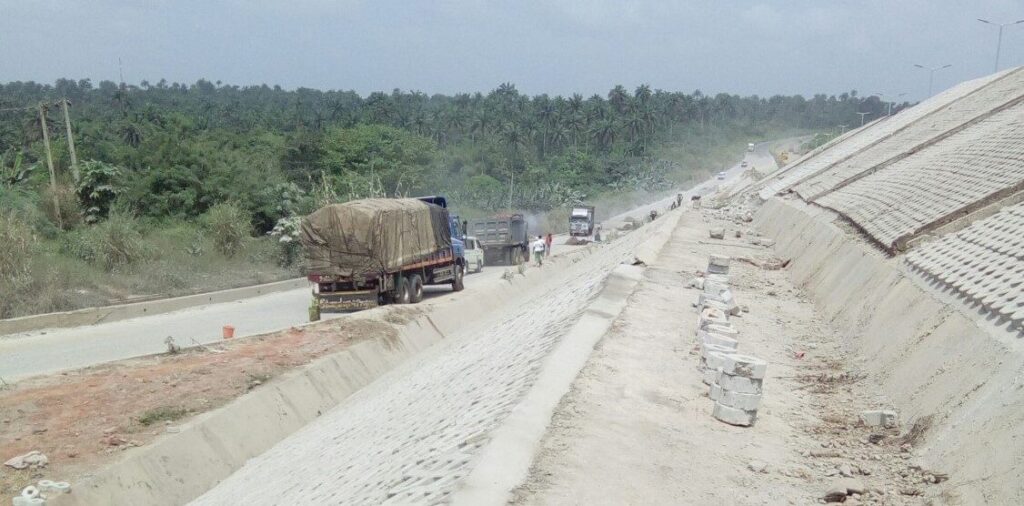
Nigeria’s federal inter-state roads are the lifelines of commerce, mobility, and national integration. Yet, their current state poses grave dangers to citizens who rely on them daily. Although recent government efforts offer a glimmer of hope, much more must be done. Responsible governance demands consistent funding, transparent project execution, strict monitoring of contractors, and a long-term national road maintenance strategy.
Until these measures are fully implemented, Nigerian travellers will continue to risk their lives on dangerous highways. The time has come for the government to prioritise road safety, not as a political achievement, but as a moral obligation to protect the lives and dignity of its citizens.
Image Credit: Premium Times
———————————————-
Facebook: Peacepace Initiative
LinkedIn: Peacepace Initiative
X:@PeacepaceNG
Instagram: peacepace_initiative
References
Amaize, E. (2025, May 14). [Article on the deplorable state of federal highways in Nigeria]. Vanguard Newspaper.
Yusuf, A., & Nimlan, R. (2021). The Nigerian Road Network: The Horror Highway of Death.
Federal Ministry of Works. (2024–2025). Reports and updates on federal highway rehabilitation and construction projects.